Here’s a more detailed look at the characteristics of the British sound:
- Warm and Non-Fatiguing: British sound is often described as warm, with a focus on a sound that is not overly bright or fatiguing to listen to.
- Smooth and Accurate: The sound is generally smooth and accurate, with good separation and clarity.
- No Harsh Highs or Bloated Bass: British sound tends to avoid overly bright highs or heavy, boomy bass.
- Round and Warm Mids and Lows: The mids and lows are often described as being rounded and warm, contributing to the overall smooth and engaging sound.
Examples of gear known for their British sound include: Allen & Heath, Neve, Sound Techniques, and, Soundcraft,
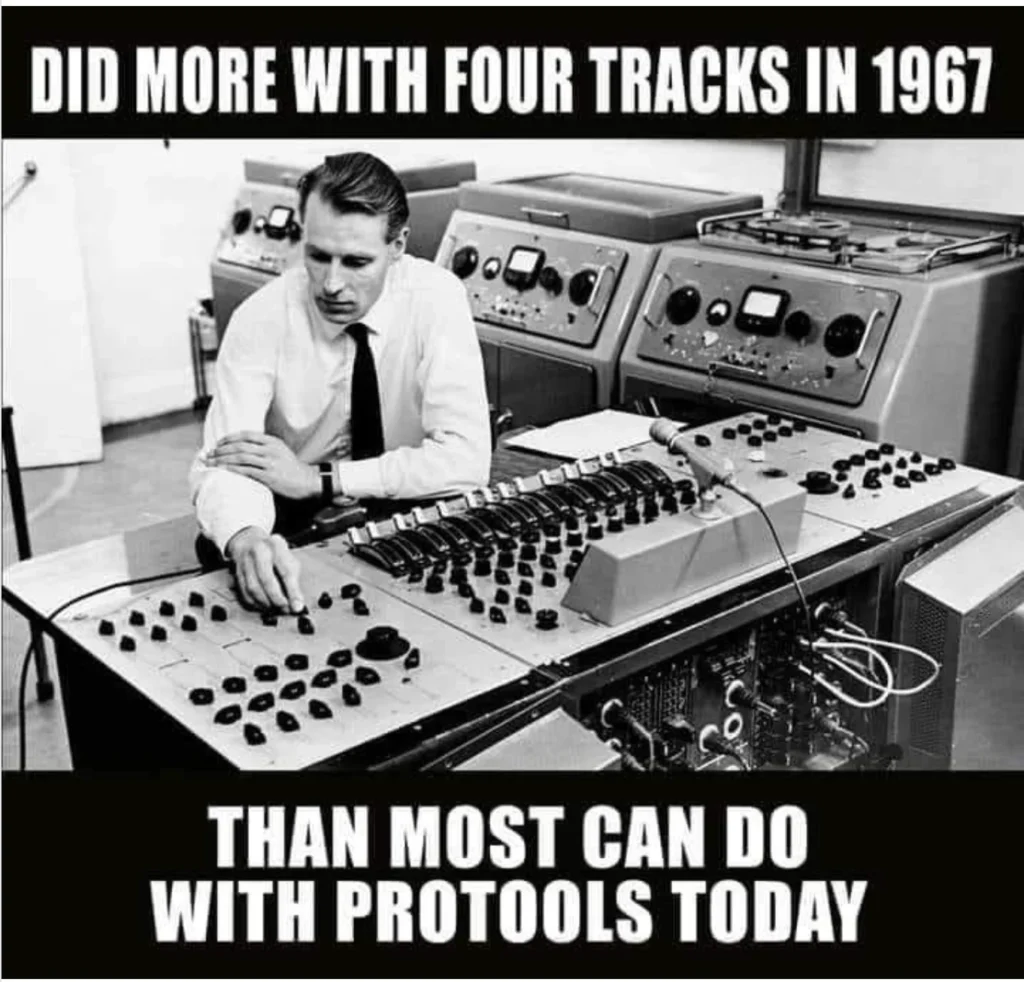
In addition to the sonic characteristics, the British sound also has a historical context. It emerged in the 1960s with artists like The Beatles, pushing the boundaries of recording techniques in the studio. This experimentation, combined with the use of British-made recording consoles and components, helped create a distinct British sound.
That British Sound – A personal perspective.
- What is it that defines “that British sound”?
- When did it start?
- What makes British professional audio equipment unique in its sound character?
In the signal chains of pro-audio recording and mixing consoles there are many types of circuit that influence the character of the sound. These circuit types are combined together to create distinctive characters for each of the console manufacturers. The choice of circuit topology and the choice of electronic components influence the sound of the final circuits. When separated out into individual functions (mic amps, equalisers, compressors, gates, etc.) the resultant functional units often find their way into the ever-popular and constantly broadening variety of “API 500 Compatible” modules. The simple concept and open-source system standards of the API 500 format means that both commercial manufacturers and amateur constructors can make modules. Apologies, I have digressed from the focus on That British Sound (API is American).
Equalisers
Starting with what is typically the second stage of the recording / mixing chain, the equaliser (British spelling) or equalizer (American spelling) is a tone control circuit that, in terms of the British sound, is characterised by its musicality, warmth and mid-range punch. The EQ, more than any other stage in the signal chain, is what really defines That British Sound in our UK designed and manufactured mixing consoles.
Early incarnations of equaliser were relatively simple with few controls. The circuitry was often passive and was followed by an amplifier to make-up the loss of level through the EQ. The Baxandall circuit topology often featured for the HF and LF bands, with additional mid bands of varying types, such as boost-only presence controls or boost and cut bands, sometimes with switched or variable frequency. The Baxandall topology has a smooth and natural sounding characteristic for boost and cut. Modern console EQ circuits are much more complex than the Baxandall and its variations, with the full-facility parametric EQs found on the likes of Neve, SSL and Calrec consoles typically having 4 bands with cut/boost controls, variable frequency, variable or switched bandwidth (Q), as well as switches on the HF and LF bands to swap between shelving and bell curves.
Up until around 1980, many EQ circuits featured inductors in the mid-bands with switched frequencies. Inductor based EQs are often described as having a “sweet” sound….. whatever that may mean….. it is certainly a positive description, and inductor-based EQs are viewed favourably. Early inductor based EQs are highly sought after and command eye-watering prices on the rare occasions that they become available for sale.
Some of the classic mixing console manufacturers, and their console models are listed below. This is by no means an exhaustive list of British mixer makers. There were many others, some small niche companies, and others of significant size. As the industry grew and evolved, there was crosspollination of ideas and technology between companies as people moved from one company to another or when companies closed-down or reduced in size or grew in size. The UK audio industry is relatively small and many people know each other either personally or through friends and colleagues.
- 1970’s, and in some cases earlier: •
- Neve 1073 and 1084, •
- Sound Techniques “Chelsea” “A-Range” and “System 12″, •
- Helios “Type 69″, •
- Trident “A-Range” •
- Raindirk, •
- Soundcraft: “Series 2″, “Series 3B” •
- EMI: TG consoles, REDD consoles, •
- Klark Teknik (not a console manufacturer) DN27 graphic equaliser.
- 1980’s: •
- Neve 51, •
- Neve 81, •
- Neve V-Series, •
- Neve VR, •
- Calrec: M-Series,
- UA8000 •
- Soundcraft: 800B, 2400, 2400, 500/600, 200B •
- SSL 4000, •
- Focusrite “Forte”, •
- Amek, “Angela”, Mozart”
- 1990’s: •
- Neve VR, •
- Calrec: Q-Series, S-Series, T-Series, •
- SSL 4000, •
- SSL 9000, •
- Focusrite:“Studio Console”, “RED2″, •
- Soundcraft: 3200, Delta, Sapphyre, Europa, •
- Amek: Rembrandt
- 2000’s •
- Calrec Q2 •
- Neve 88R
- 2010’s & 2020’s •
- Sound Techniques: ZR console •
- Sound Techniques: ZR7064 rack-mount mic pre & EQ •
- Sound Techniques: “Mersey” EQ in the API500 format.
Many of the 1970’s EQs (excluding Soundcraft) were inductor based. Inductors fell out of favour with manufacturers due to their cost, and were replaced by the much cheaper “gyrator” circuit topology or other forms of resistor/capacitor/amplifier circuits. In 2018 Sound Techniques launched the ZR console at the January NAMM show, which features inductors in the HF, high-mid and low-mid bands. This is one of the very few modern consoles that has inductors in its EQ. The ZR console and the ZR7064CS rackmount mic-pre & EQ product have been well received.
The “state variable filter” is often the core circuit for each section of a parametric EQ. A careful study of the EQ circuits of the console manufacturers will often show core similarities that can be traced back to the state variable design. The variations on the theme and the choice of components are what yield the differences in the sound between products. The Sound Techniques “Mersey” equaliser is an API500 style module that is based on the state variable design.
Mic Amps
This is the first block of circuitry in the recording signal chain. There are 4 main types of mic input stage: • Transformer, • Transistor, • Op-amp chip, • Specialist chip (e.g. That Corporation 1510 and 1512) These are often combined in various configurations to achieve up to 80dB of gain at very low noise and very low distortion and with a flat frequency response. Some of the configurations that are used are: • Transformer + transistors • Transformer + transistors + op-amp • Transformer + op-amp• Transistors • Transistors + op-amp • Transformer + specialist chip • Specialist chip. Transistor & chip mic-amps are typically described as being “clean”. Sometimes they are disparagingly described as “cold” or “soul-less”. Transformer-based mic-amps, on the other hand, are typically described as being “warm” and “fullbody”. Looking back at the list of console manufacturers, the vast majority had or have transformerbased mic-amps. The exceptions being 1980 onwards Soundcraft, some Calrec, some SSL, and some Amek consoles. Early SSL 4000 consoles had transformers, later SSL 4000 consoles did not. All the Neve consoles listed had transformers, as did all of the Sound Techniques consoles. Soundcraft offered transformer input options on some of their 1980’s consoles. These were 1:1 directly wired-in and did not have any compensating components to control ringing. I have not had the opportunity to carry out detailed tests to assess the optional transformer-coupled mic inputs and I therefore do not know for sure whether the compensating components were actually required or not.
Dynamics
It is only the high-end consoles that feature on-board dynamics, either as a channel facility or as a master section facility. The dynamics from each different manufacturer imparts its own personality to the sound when the dynamics is switched into circuit: • Neve 51 has a limiter per input channel. It is simple and does what it’s meant to do, especially in the broadcast environment, which is where the 51 market was focussed. • Neve VR and 88R have comprehensive compressor / limiter / expander / gate dynamics on each channel module. These are great character dynamics and can be used for both signal control and dynamics effects. • Soundcraft 3200 had a gate on each channel. • SSL is famous for its Bus Compressor, and the channels all have comprehensive dynamics. • Sound Techniques ZR has a comprehensive bus compressor. When set at a low ratio, it has the pleasing effect of “pulling together” a mix in a notably transparent manner.
Signal Summing
The way that the signals in a console are summed together can have a big influence on the “sound” and character of the console. The most common form of summing is current summing, also known as virtual earth summing. Signals are switched into resistors that feed a mix bus that is fed into a summing amplifier circuit. As with all aspects of console design, there are variations on the theme, some of which are: • Unbalanced summing (used by almost all mixer manufacturers) • Balanced summing (used on Neve V-Series, 88R and Soundcraft 3200) • Devolved summing, where blocks of “n” channels are summed, then the output from each block is summed. (Focusrite Studio Console and Sound Techniques ZR). The summing amplifiers that are used to convert the mix bus currents back to voltage are REALLY important for the quality of the summed signal and its signature sound. A summing amplifier is supposed to be totally transparent; i.e., it is supposed to add nothing to the signal and detract nothing from the signal: summing and buffering the signal is all it is supposed to do. Signal quality is a function of the console’s mix circuit and PCB design process. Signature sound is a function of the summing amp components and the mix amplifier circuit design. For example, a cheap op-amp that has a less than ideal spec for audio use will possibly have a “thin” sound that lacks depth, whereas a high-quality op-amp that has a design focus on audio applications is likely to have a “full range” sound. The choice of summing amplifier components is really important and the four major factors of noise, frequency response, distortion and dynamic range all have to be considered. Of equal importance is the layout of the summing amp PCB, where factors including ground impedance, crosstalk, stability, susceptibility to interference, component placement, power distribution, and grounding, all have their own specific influences on the final performance of what islikely the most important set of amplifiers in the console. In the time I have been working in pro-audio, the 4 most common types of summing amp I have seen are: • Op-amp, • Transistor, • Transistor + op-amp • Specialist chip. Each has its own merits, drawbacks and limitations. An example of change of character of sound is in the Neve VR console. The standard VR has balanced buses and uses a 3 op-amp summing configuration for the 4 (or sometimes 8) main mix buses. The 3 op-amp summing configuration sounds good and is complimented by a set of technical performance measurements that are excellent. All of this is what is expected from a large-format mixing console at the top end of the industry. A variant of the VR is the “VR Legend” console. It has essentially the same channels as a standard VR (with a minor change). Everything else in the console remains the same, EXCEPT the mix card (or pair of cards in the 8-bus variant). For the main mix bus summing, the Legend mix card uses specialist chips that are long obsolete and no longer available. The Legend sound is different to the standard mix amp; it is more “open” with a greater “depth” when compared to the standard VR mix amp. This is an interesting example of how physical hardware can change the sound of a console. The lack of availability of the chips used in the Legend mix amp is a real problem for console owners who expect the best performance from their consoles and who suffer component failure. To address the problem of the long obsolete Legend summing amp chips, a colleague of mine has thoroughly analysed the bussing and mixing topology of the VR console and has developed a new “Legend Plus” mix circuit. We have designed a PCB, the “GSM694 Legend+ Mix Amp” that is directly compatible with VR and VR Legend consoles. Its sound is comparably better than the VR Legend mix amp and its technical performance exceeds that of the VR Legend mix amp. It is our contribution to keeping the highly regarded VR console type at peak performance with that British sound that has come to define much of the professional audio industry.